
18 Things to Do in Cinque Terre (From a Local Skipper)

We’ve spent more mornings on this stretch of coast than we can count. We’ve watched the light hit Vernazza at seven in the morning and we’ve watched a thousand day-trippers arrive at eleven and leave at four having seen almost nothing.
So this isn’t a list scraped from other lists. It’s what we’d tell a friend arriving next week — including the parts most guides leave out, like which village is genuinely worth your time and why the “must-do” hike might not be the best use of your afternoon.
First, the thing nobody tells you
The Cinque Terre is five villages — Monterosso, Vernazza, Corniglia, Manarola, Riomaggiore — strung along nine kilometres of cliff on the Ligurian coast. They’re close together. You can technically see all five in a day.
You shouldn’t.
The single biggest mistake we see is treating this place like a checklist. People sprint through five villages, photograph each one from the same spot everyone else photographs it from, and go home with a camera roll and no memory. Three villages done slowly beats five done fast. Every time.
Here’s what’s actually worth doing.
The essentials
1. See the villages from the water
We’ll declare our bias immediately — this is what we do for a living. But there’s a reason we built a business on it.
The Cinque Terre was built facing the sea. The villages were fishing communities; their fronts, their colours, their whole logic points at the water. When you arrive by train you enter through the back door, into a tunnel and up a staircase. From a boat you see what the place was designed to show you: the terraced hills stacked behind, the churches on the cliffs, the whole coast unfolding at once.
There’s also a purely practical argument. From the sea you understand the geography in twenty minutes — how the villages sit, how far apart they are, why the trails climb the way they do. Everything you do afterwards makes more sense.
Boat tours run from Monterosso and typically last two hours for the full coastline. We run ours from the Fishermen’s Wharf on a traditional Ligurian gozzo, with a swim stop along the way.
2. Swim in a cove you can’t walk to
Between the villages the coast is broken up by small rocky inlets. No path reaches them. No signs point at them. They’re empty at midday in August while the beaches are packed shoulder to shoulder.
This is, honestly, the single best thing about being on a boat here. You cut the engine somewhere between Vernazza and Corniglia, the water is that particular Ligurian green-blue, and there is nobody. In the highest season on one of Italy’s most visited coastlines, there is nobody.
Bring a mask. The rock shelves drop away fast and the visibility is excellent.
3. Spend real time in Monterosso
Monterosso is the largest of the five and the only one with a proper sandy beach. Some guides treat it as the least “authentic” village for exactly this reason. We think that’s snobbery.
It’s split in two: the old town, where the boats dock, all narrow lanes and the striped church of San Giovanni Battista — and Fegina, the newer half with the train station and the Neptune statue carved into the rock. Walk between them through the tunnel or over the headland.
It’s also the easiest village to base yourself in. More space, more restaurants, an actual beach to come back to. If you’re travelling with kids or you don’t love staircases, stay here.
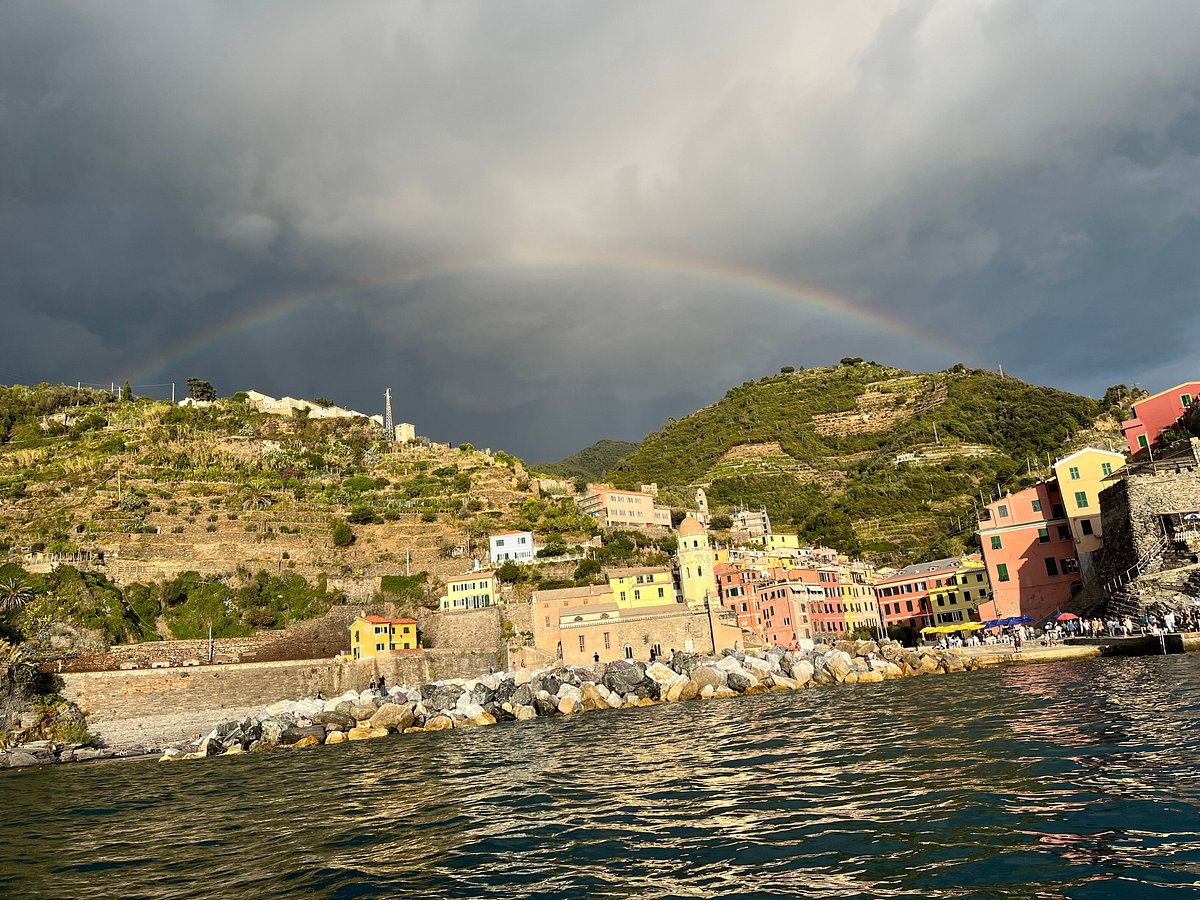
4. Arrive in Vernazza by sea
Vernazza is the postcard. A natural harbour, a ring of coloured houses, the medieval church of Santa Margherita di Antiochia sitting almost in the water, the Doria castle tower above.
By land you arrive from behind and above. By sea you come into the harbour exactly as fishermen have for eight hundred years, and the whole amphitheatre opens up in front of you. It’s a genuinely different experience of the same place.
Ten minutes of climbing to the Belforte tower gets you the view back down over the harbour. Worth it.
5. Watch the sunset from Manarola
Manarola stacks up a rock face in a way that shouldn’t work and does. In the late afternoon the low light hits the western faces of the houses and the colours go absurd — ochre, salmon, burnt orange, all of it doubled in the water below.
The classic viewpoint is along the Punta Bonfiglio path, past the cemetery. Get there before the light drops, not during.
6. Climb up to Corniglia
Corniglia is the odd one out: the only village with no harbour, perched a hundred metres up on a headland, surrounded by vineyards instead of boats. From the train station it’s 382 steps — the Lardarina staircase — or a shuttle bus if you’d rather not.
Because of those steps it gets a fraction of the crowds. It feels like a hill village that happens to be near the sea, which is exactly what it is. The terrace at the end of Via Fieschi looks out over the whole coast.
We should be honest here: Corniglia is the one village you can’t visit by boat. No harbour, no landing. From the water you see it the way it was meant to be seen from below — hanging over the cliff — but you’ll need the train or the trail to walk its streets.
7. Stand at the edge of Riomaggiore
The last village going east, and the one that photographs best from the water — a single ravine of coloured houses tumbling down to a tiny harbour full of boats hauled up on the slipway.
The little marina is the place to sit at the end of the day. Order something, watch the light change on the rocks.
Getting around
8. Take the train at least once
The regional train links all five villages, tunnelling through the headlands. Between neighbours it’s a matter of minutes. It runs frequently, it’s cheap, and in high season it’s the fastest way to move.
It’s also completely blind — you’re in a tunnel most of the time, popping out for two seconds of daylight at each station. Efficient, not scenic. Use it to move, not to see.
9. Walk one trail — not all of them
The trail network is genuinely spectacular and genuinely demanding. The famous Via dell’Amore between Riomaggiore and Manarola is the short flat one and reopened after years of closure. The Monterosso–Vernazza section is the hard one, and the most rewarding: about two hours of proper climbing with the best views on the coast.
Two things nobody tells you. First, most trails require a Cinque Terre Card. Second, sections close after rain and landslides, sometimes for years — always check the current status before planning your day around one.
Our honest advice: pick one section that matches your fitness, do it in the morning, and don’t build the whole trip around hiking unless hiking is why you came.
10. Combine boat and train
The move that works best: boat one way, train back. You get the coastal perspective and the swim, then a five-minute ride home instead of an hour of walking uphill in the heat.
Eat and drink
11. Eat anchovies in Monterosso
Monterosso anchovies have protected designation status and they bear no relation to the salty things on a supermarket pizza. Fresh, marinated in lemon, or fried whole. Order them where the boats come in, not on the main tourist drag.
12. Have pesto where it was invented
Liguria is the birthplace of pesto, and the basil grown on these terraces is smaller-leafed and sweeter than what you’ll find elsewhere. Trofie or trenette, with green beans and potato in the pasta. It’s a different dish here.
13. Try the local white wine
The terraces climbing the hills behind the villages are vineyards, farmed by hand on walls built over centuries. The wine — Cinque Terre DOC, and the sweet Sciacchetrà — is made in tiny quantities and mostly stays here.
14. Aperitivo facing west
Anywhere with a view of the water, an hour before sunset. This is the most Ligurian thing you can do and it costs the price of a drink.
Doing it well
15. Come in May, June, September or early October
July and August are hot and very crowded. The shoulder months give you warm sea, manageable crowds, and better light. September is our favourite month — the water is at its warmest after a summer of heating, and the day-trippers have thinned out.
Winter is quiet and beautiful but many businesses close and boat tours don’t run.
16. Start early or stay late
Day-trippers arrive around 11am and leave by 5pm. The villages before nine and after six belong to the people who live in them. If you’re staying overnight, those hours are the reason.
17. Wear the right shoes
Everything here is stairs, cobbles and uneven stone. We’ve watched too many people attempt Corniglia in sandals. Bring something with grip.
18. Give yourself two nights
One day gets you photographs. Two nights gets you a morning swim, an evening when everyone else has gone, and a meal you’re not rushing. It’s the difference between visiting and being here.
A realistic two-day plan
Day one. Arrive, settle in Monterosso. Late morning boat tour along the whole coast with a swim stop — it orients you and everything after makes sense. Afternoon in Vernazza, train back. Aperitivo, dinner, early night.
Day two. Early train to Corniglia before the crowds, walk its streets. Down to Manarola for lunch and the Punta Bonfiglio walk. Train to Riomaggiore for the late light at the harbour. Back to Monterosso for dinner.
That’s five villages in two days, unhurried, with a swim and a sunset in it.
Frequently asked questions
How many days do you need in the Cinque Terre?
Two nights is the sweet spot — enough for all five villages plus a boat trip and some unhurried time. One day is possible but you’ll spend it moving. Three nights if you want to hike properly as well.
What’s the best way to see all five villages?
A combination. The boat gives you the coastline and the perspective the villages were built for; the train moves you quickly between them; walking is how you actually see each one. Boat one way and train back is the most efficient version.
Can you swim in the Cinque Terre?
Yes. Monterosso has the only real sandy beach, and there’s swimming off the rocks at Vernazza, Manarola and Riomaggiore. The best swimming is in the coves between the villages, which are only reachable by boat.
When is the best time to visit?
May, June, September and early October. September in particular — warmest sea, fewer people, excellent light. Avoid August if crowds bother you.
Which village should I stay in?
Monterosso for space, a beach and easy access. Vernazza for the most beautiful setting. Riomaggiore for good transport links and a livelier evening. Corniglia only if you genuinely don’t mind the stairs.
Do you need a car?
No — and it’s an active disadvantage. The villages are closed to traffic and parking is scarce and expensive. Arrive by train.
See it from the water
Everything above is worth doing. But if you only add one thing to the standard itinerary, make it the sea.
We run boat tours from the Fishermen’s Wharf in Monterosso on a traditional Ligurian gozzo — two hours along the full coastline with a swim stop in a cove you couldn’t otherwise reach, or four hours if you want to carry on to Portovenere and the Gulf of Poets. Small groups, local skippers, and no commentary through a loudspeaker.


Book With Extra Flexibility
Choose new departure dates if your plans change.
Reach out to us anytime via online chat, phone or email.
Get credit for future trips if you need more time to decide.
Change to a different tour run by the same tour operator.
